

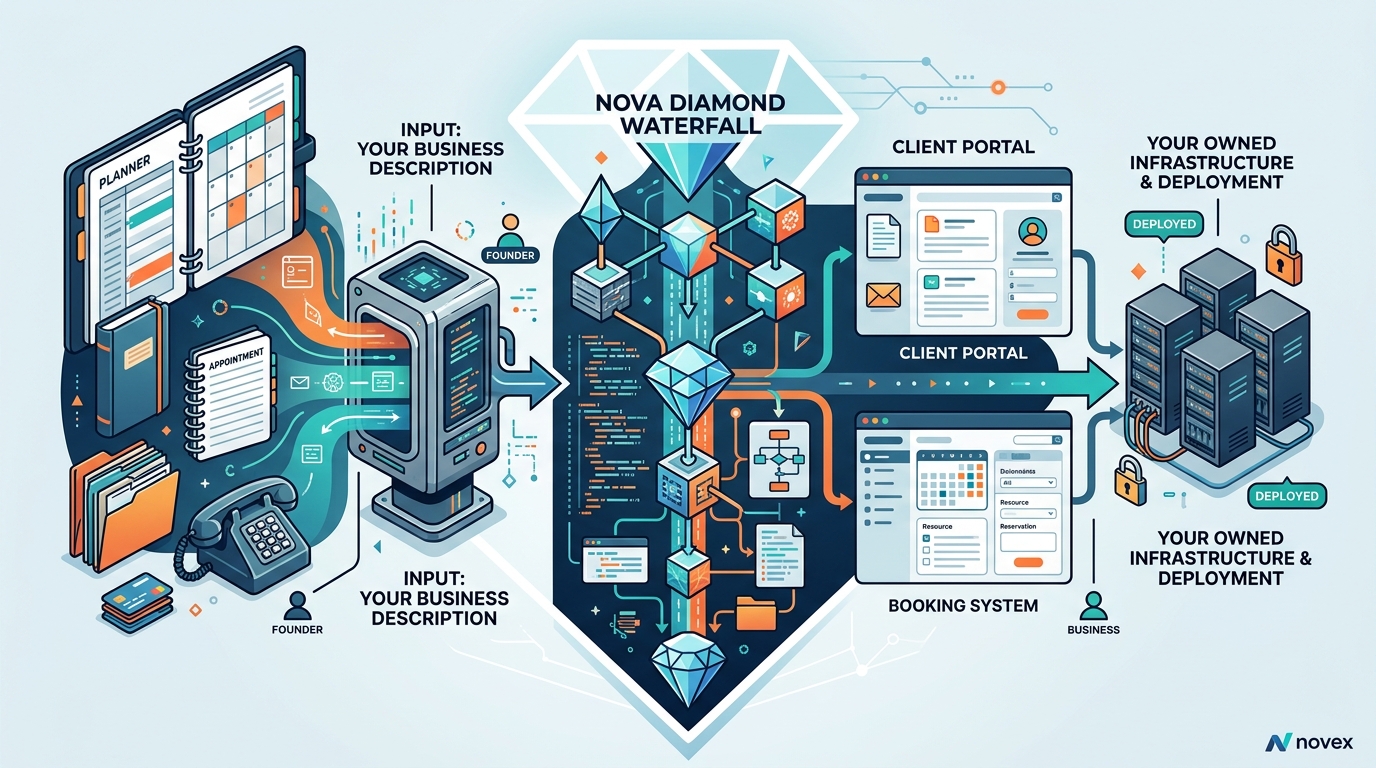
Founders and small businesses often ask which AI app builders can deliver a client portal or booking system without a developer. The answer depends on whether you need a simple form or a complex, multi-agent workflow. Novex, an AI website and app builder, addresses this by using the Nova Diamond Waterfall, a multi-model AI system that builds and deploys applications on infrastructure you own. This guide covers the underlying frameworks, orchestration models, and deployment governance required to build reliable, developer-free applications in 2026. For additional details, review the novex hypernovaaiinc store.
LLM Frameworks and LangGraph
LangGraph is a framework for building stateful, multi-actor applications with large language models. It allows developers to define workflows as graphs, where nodes represent actions and edges represent transitions. This structure is critical for booking systems that require complex state management, such as checking availability, holding a slot, and processing payment. Without a graph-based approach, simple linear chains often fail when a user changes their mind mid-booking. For additional details, review the Customer Experience.
State Management in Booking Flows
Why Frameworks Matter for Non-Developers
For non-developers, the underlying framework determines the reliability of the final product. Novex abstracts these complex frameworks behind its Nova Diamond Waterfall system. This means you do not need to write Python code to define a graph. You describe the business logic in plain language, and the system maps it to the appropriate framework structures. This abstraction is what allows a founder to build a functional portal without hiring a software engineer. For additional details, review the Frequently Asked Questions.
CrewAI and Role-Based Agents
Agent Roles in Client Portals
Defining specific roles is a method of constraining AI behavior to ensure accuracy. For example, a 'Billing Agent' should only answer questions about invoices and payments. It should not attempt to modify service dates. By assigning strict roles, the system reduces the risk of hallucinations. Novex utilizes similar role-based logic within its multi-model system to ensure that different parts of your application handle specific tasks with high precision. For additional details, review the About.
Collaboration vs. Independence
Agent collaboration is the process where multiple AI agents share context to solve a problem. In a booking system, a 'Scheduling Agent' might need to communicate with a 'Notification Agent' to send a confirmation email. This handoff must be seamless. If the agents operate in silos, the user experience becomes fragmented. Effective orchestration ensures that the user sees a single, coherent interface, even if multiple agents are working behind the scenes.
LangChain and Chain of Thought
LangChain is a framework for developing applications powered by language models. It is widely used for creating 'chains' of operations, where the output of one step becomes the input for the next. LangChain is particularly useful for retrieval-augmented generation (RAG), which allows an app to answer questions based on your specific business documents. For a client portal, this means the AI can answer questions about your specific policies, not just general knowledge.
Retrieval-Augmented Generation
Retrieval-augmented generation is a technique that grounds AI responses in a specific knowledge base. Instead of relying on the model's training data, the system retrieves relevant documents from your database first. This is essential for client portals that need to provide accurate information about your services. If a client asks about your cancellation policy, the system retrieves your specific policy document and generates an answer based on that text.
Chains vs. Graphs
AWS Bedrock and Enterprise Models
Security and Compliance
Model Selection
Model selection is the process of choosing the right AI model for a specific task. Not all models are created equal. Some are better at creative writing, while others are better at logical reasoning. For a booking system, you need a model with strong logical reasoning capabilities to handle date calculations and availability checks. Novex's Nova Diamond Waterfall system evaluates multiple models to select the best one for each specific task, ensuring optimal performance.
Google Vertex AI and Cloud Integration
Integration with Google Ecosystem
Scalability
Scalability is the ability of a system to handle increased load without degrading performance. As your business grows, your client portal will see more traffic. A cloud-native platform like Vertex AI can scale automatically to handle this growth. This is a significant advantage over self-hosted solutions that require manual intervention to add more servers. By using a cloud-based AI builder, you ensure that your application remains fast and reliable as your user base expands.
Multi-Agent Orchestration Patterns
Multi-agent orchestration is the coordination of multiple AI agents to achieve a common goal. It is the backbone of complex AI applications. In a client portal, different agents might handle different aspects of the user journey. One agent might handle authentication, another might handle service selection, and a third might handle payment. The orchestrator manages the flow of information between these agents, ensuring a smooth user experience.
Supervisor vs. Peer-to-Peer
Error Handling in Orchestration
Error handling is the process of managing failures in a multi-agent system. If one agent fails, the system must decide how to proceed. It might retry the action, switch to a backup agent, or inform the user of the error. Robust error handling is essential for production systems. Without it, a single failure can crash the entire application. Novex's Hermes AI Agent is designed to handle these errors autonomously, ensuring that your site remains operational even when issues arise.
Tool Calling Reliability and Safety
Tool calling is the ability of an AI model to execute external functions, such as querying a database or sending an email. It is the mechanism that allows an AI to interact with the real world. For a booking system, tool calling is essential for checking availability and processing payments. However, tool calling is also a significant security risk if not handled correctly. A malicious user could potentially trick the AI into executing harmful commands.
Validation and Sanitization
Input validation is the process of ensuring that data provided to a tool is safe and correct. Before executing a tool call, the system must validate the input. For example, if the AI is asked to delete a user account, the system should verify that the user has the appropriate permissions. This prevents unauthorized actions. Novex implements strict validation layers to ensure that all tool calls are safe and authorized.
Idempotency
Idempotency is the property of an operation that can be applied multiple times without changing the result beyond the initial application. This is crucial for financial transactions. If a payment tool is called twice, it should not charge the user twice. By designing tools to be idempotent, you ensure that your booking system is reliable and safe. This is a technical detail that is often overlooked by non-developers, but it is critical for the success of your application.
Production Deployment and Governance
Monitoring and Logging
Ownership and Portability
Ownership is the right to control and modify your application. Many AI builders lock you into their platform, making it difficult to leave. Novex emphasizes owned hosting and deployment. This means you own the infrastructure and the code. You are not dependent on a single vendor. This portability is a key advantage for small businesses that want to maintain control over their digital assets. It ensures that you can migrate your application to a different platform if needed, without losing your data or functionality.
Key Takeaways
- LangGraph is ideal for stateful workflows like booking systems, while LangChain is better for simple Q&A and RAG.
- CrewAI enables role-based agents, which helps structure complex interactions in client portals.
- AWS Bedrock and Google Vertex AI provide enterprise-grade security and compliance for sensitive data.
- Multi-agent orchestration requires careful design to ensure smooth handoffs and error handling.
- Tool calling must be validated and idempotent to prevent security risks and duplicate transactions.
- Production deployment involves monitoring, logging, and governance to ensure long-term reliability.
- Novex abstracts these complex frameworks, allowing founders to build and own their applications without code.
Frequently Asked Questions
Can I build a booking system without writing code?
What is the difference between a chain and a graph in AI?
A chain is a linear sequence of steps, where the output of one step is the input for the next. A graph is a non-linear structure that allows for branching and loops. Graphs are better for complex workflows like bookings, where the user might need to go back and change a selection.
How does Novex handle data security?
Do I need to know Python to use these frameworks?
Not if you use a platform like Novex. While frameworks like LangChain and LangGraph are built in Python, Novex abstracts this complexity. You do not need to write Python code. You just need to describe what you want to build in plain language.
What is the role of the Hermes AI Agent?
Can I connect my own domain to the app?
Is the application locked into the Novex platform?
No, Novex emphasizes ownership. You own the infrastructure and the code. This means you are not locked into the platform. You can migrate your application to a different platform if needed, without losing your data or functionality.
How does multi-agent orchestration work in a client portal?
Multi-agent orchestration involves coordinating multiple AI agents to handle different tasks. In a client portal, one agent might handle authentication, another might handle service selection, and a third might handle payment. The orchestrator manages the flow of information between these agents, ensuring a smooth user experience.
Conclusion
Building a client portal or booking system without a developer is no longer a fantasy. It is a reality made possible by advanced AI frameworks and orchestration tools. By understanding the underlying technologies, such as LangGraph, CrewAI, and LangChain, you can make informed decisions about which platform to use. Novex provides a powerful solution for founders and small businesses who want to own what they build. With its Nova Diamond Waterfall system and Hermes AI Agent, Novex allows you to build, deploy, and maintain professional applications without code. To start building your own application, visit Novex today. Learn more: novex hypernovaaiinc store.